MFG-82 Series Quadrupole Coils|SeeweTek | Magnetic Field Generators, Magnetic Testing Solutions, Physical Property Testing Solutions

Expand
MFG-82 Series Quadrupole Coils
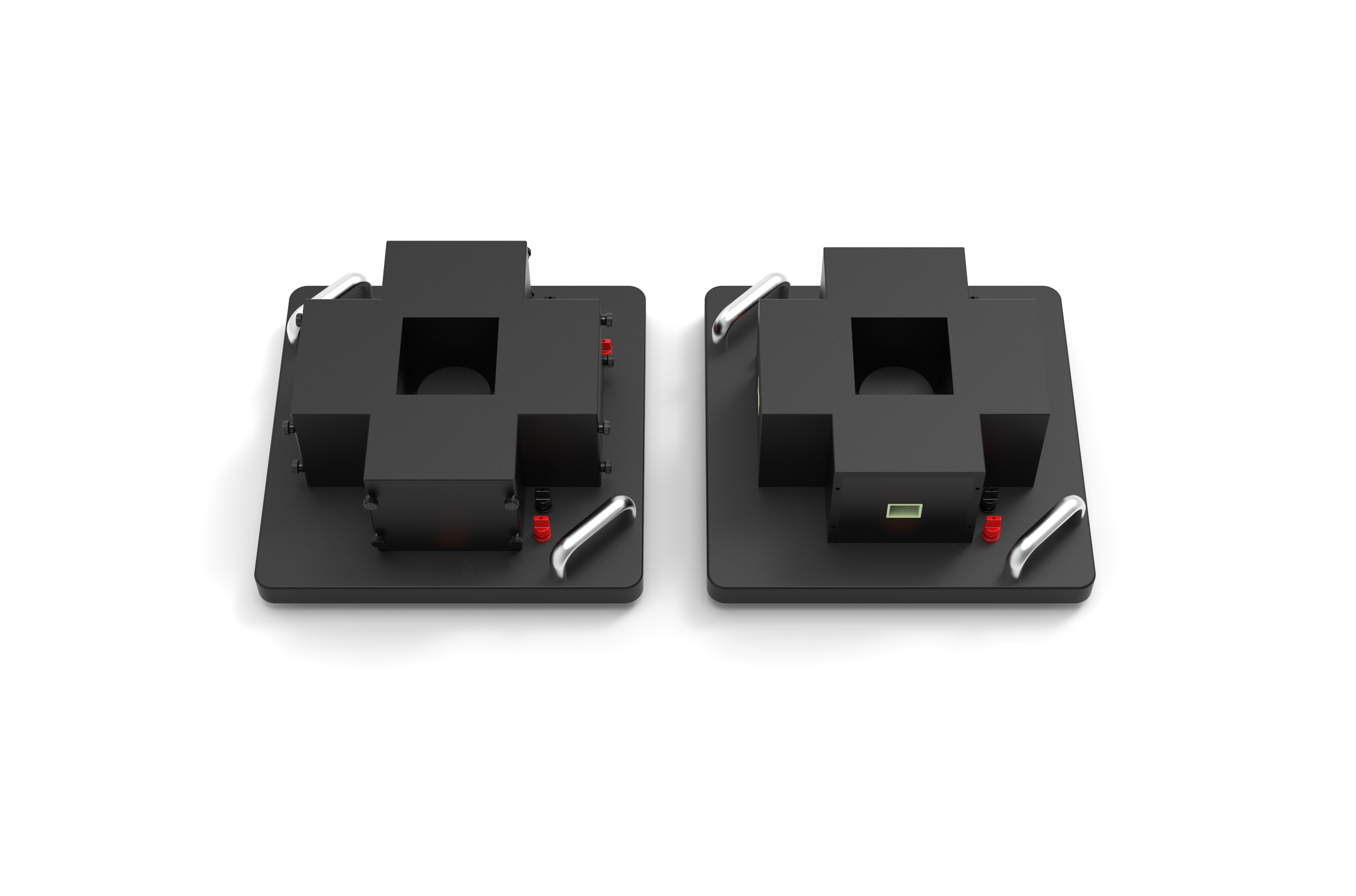
Description:The MFG-82 series quadrupole coils, unlike quadrupole electromagnets, produce a magnetic field that has good linearity with the current, making them easier to control. This device can generate various types of magnetic fields depending on the operation and configuration, such as DC uniform fields, gradient fields, rotating fields, and alternating fields. It is suitable for research institutions, universities, and corporate R&D centers for studies on hysteresis, magnetic susceptibility measurement, Hall effect, magneto-optical experiments, nuclear magnetic resonance, magnetic measurements, magnetic material orientation, spin magnetic resonance demonstrations, and biological research.
Category:
Detail
Parameter
Other

Product Features

  • This device can generate various types of controllable magnetic fields through different wiring and excitation methods, as follows:
  1. Wiring opposite coils with the same polarity produces a uniform magnetic field in the central region;
  2. Wiring opposite coils with opposite polarity produces a gradient magnetic field in the central region;
  3. Applying AC current to any pair of opposite coils generates an alternating magnetic field in the central region;
  4. Applying AC currents with a 90° phase difference to two pairs of opposite coils generates a rotating magnetic field in the central region;
  • The housing and frame are made of non-conductive materials for insulation, ensuring safe use;
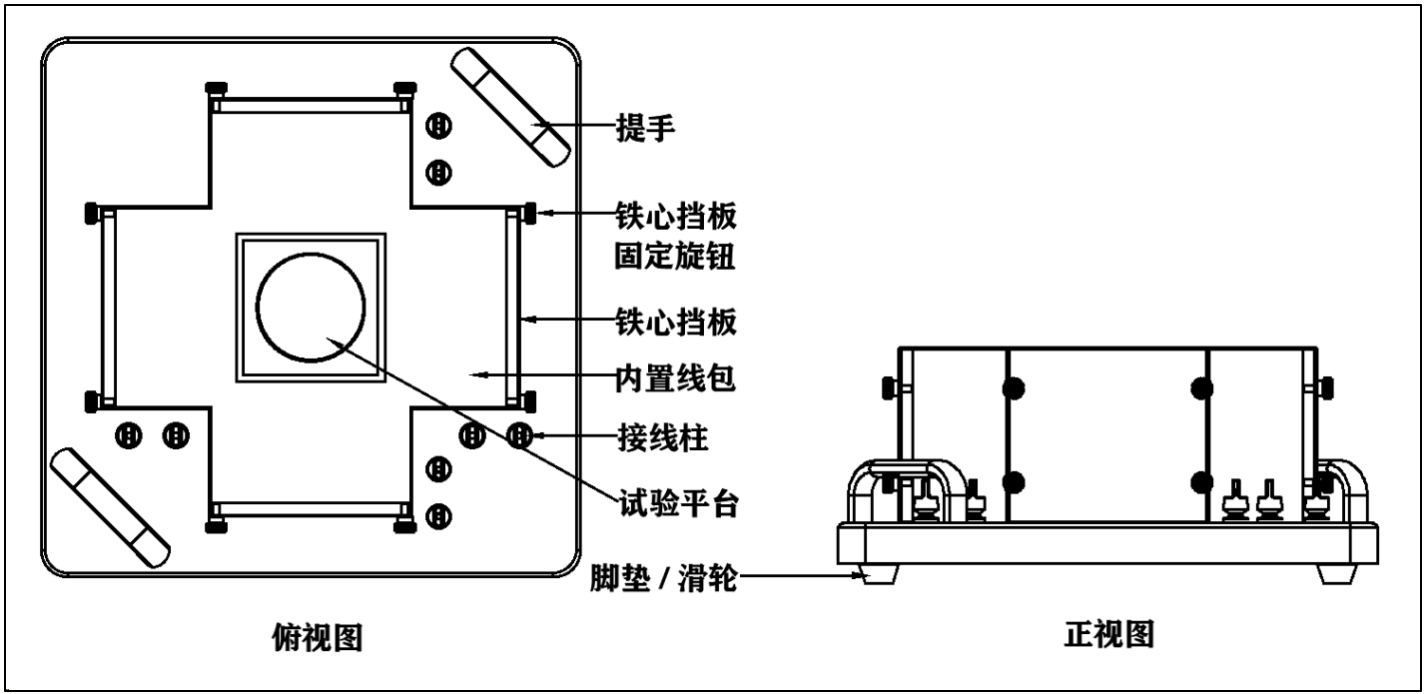
  • The device can be optionally equipped with an iron core to enhance the magnetic field in the central region, but this increases the power load under AC excitation and may cause nonlinearity between the excitation current and the magnetic field.
  • All parameters can be flexibly customized according to user requirements.

Applications

  • Magnetic material measurement
  • Research on magnetic field effects such as Hall effect, magneto-optical effect, magnetoresistance effect, and biological effects of magnetic fields
  • Scientific research directions related to magnetic fields

Magnetic Field Types

  • Constant magnetic field
  • Gradient magnetic field
  • Rotating magnetic field
  • Alternating magnetic field

Technical Specifications

Quadrupole Coil Parameters Example The following is an example of quadrupole coil parameters. All parameters can be customized according to user requirements:
ModelMFG-8200-100
Magnetic flux density at air gap center (20A DC bipolar power supply)18 mT
Magnetic flux density at air gap center (20A DC quadrupole power supply)25 mT
Central working space100mm x 100mm
Cold resistance of single coil0.6 Ω
Magnetic field distributionSee simulation report
Overall dimensions (L×W×H)400mm x 400mm x 175mm
OthersOptional: "Non-magnetic test platform" Optional: "Removable iron core function"
Note: Operating time depends on coil heating.


Basic Structure


System Configuration List

NameModelQtyUnitConfigRemarks
Quadrupole CoilMFG-82 Series1SetStandardCustomizable based on size and maximum flux density requirements
Full set of test leads and power cables——1SetStandard
Removable iron core functionMFG-82101SetOptionalQuadrupole coil structure needs modification.
Excitation power supplyMAC-11 SeriesSetOptionalCan be selected based on excitation requirements of the quadrupole electromagnet
Test platformMAC-42 Series1SetOptionalCan be selected or customized according to test requirements for moving, rotating, or fixing test samples
Mobile platformMAC-43 Series1SetOptionalFor easy overall movement of the coil
GaussmeterMTE-11 Series1SetOptionalCan be used to measure the magnetic field generated by the electromagnet


Simulation Report Example

Simulation services and reports can be provided according to user needs, including overall magnetic field distribution, magnetic field distribution on each axis (X-axis, Y-axis, Z-axis), overall magnetic field uniformity analysis, magnetic flux density distribution, etc. Some simulation examples are as follows: Excitation current curve


Magnetic flux density curve


Note: Due to manufacturing processes, materials, environmental factors, and measurement errors, there may be some deviation between simulation results and actual measurements, so they are for reference only. Please consult our company for more detailed simulation results.